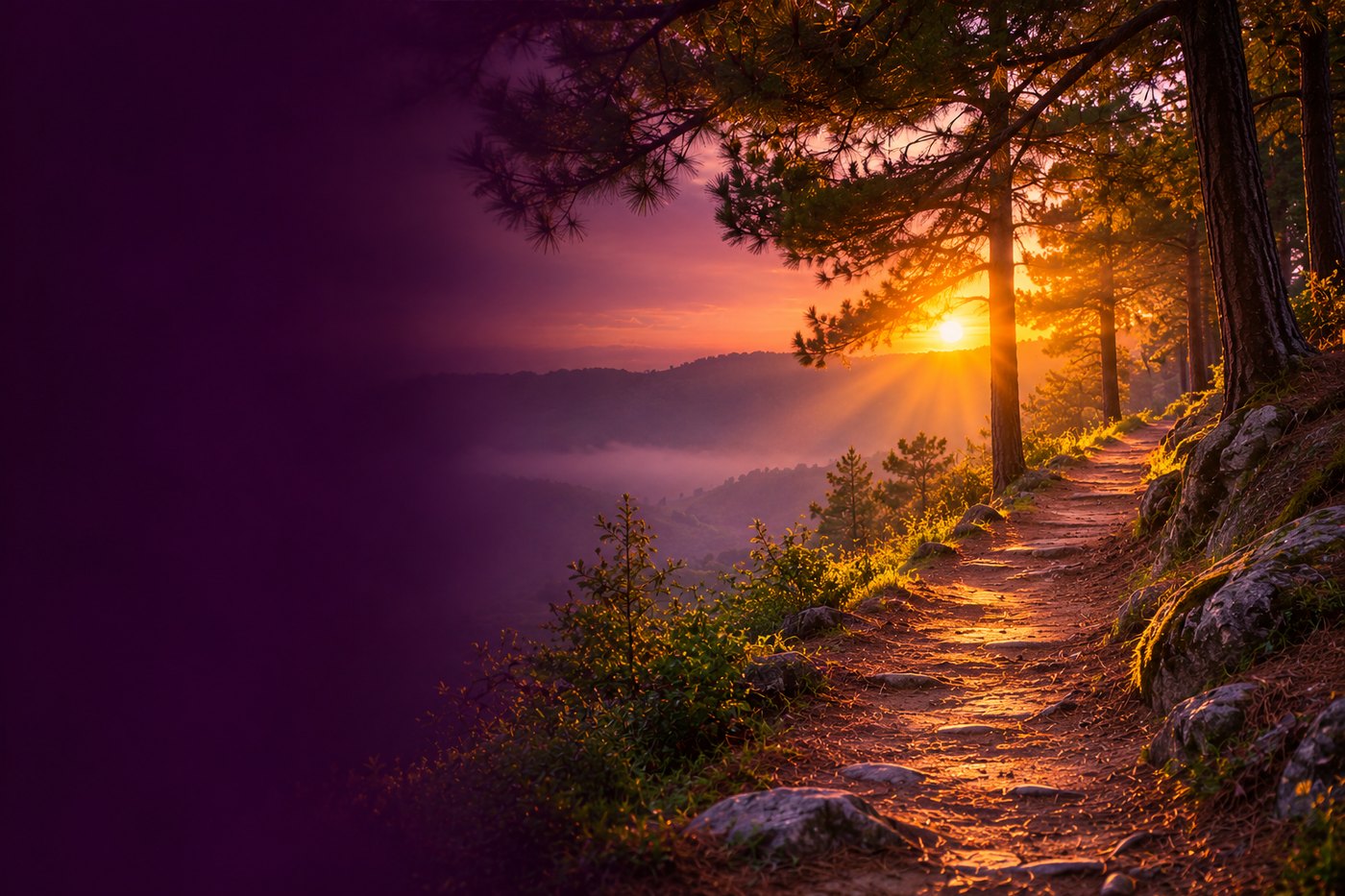
Geeta, 58, lives in Shimla, and every morning she walks the Mall Road. She leaves at a quarter to six with earphones in, a list of worries in her head and a pace that would suit a train she is about to miss. The deodars are on one side and the valley is on the other, and she has not looked at either for years.
By seven she is home, her legs a little tired and her head a lot tired. She tells her neighbour the walk “keeps her healthy”, and that is true of the legs. About the head, she is not so sure.
Keep that road in mind. We will come back to it. First, let us ask why a walk can leave the mind more crowded than it found it.
The walk that only moves the body
Most of us walk the way we eat lunch at the desk. The body does the work while the mind is somewhere else, usually in the future. On the Mall Road, Geeta’s feet are in Shimla and her attention is in her daughter’s visa file, the gas bill and a remark someone made at the temple.
So the walk becomes one more place to rehearse worry, with better scenery that nobody sees. The legs finish their round, and the mind has simply done a longer shift.
This is not a failure. It is what an untrained mind does with free time. The good news is that you already have the time. What is missing is a place for attention to stand.
The reframe: stillness can travel
We grow up believing meditation means sitting still, preferably cross-legged, preferably in a quiet room, preferably for a long time. If that is the definition, then anyone with a full day will always be “too busy to meditate”.
Here is another way to see it. Stillness is not a position of the body. It is a quality of attention, and attention can come along on a walk. The body moves, and the mind stays home.
The body moves, and the mind stays home.
This changes the question. You stop asking “When will I find thirty minutes to meditate?” and start asking “What is my attention doing during the thirty minutes I already walk?” The first question needs a new hour. The second needs only a decision.
What the body gives you
Walking is rhythmic, and rhythm is one of the oldest ways the body settles itself. Think of how a baby quietens when she is rocked. Steady left, right, left, with the breath finding its own pace, tells the nervous system that nothing urgent is chasing you.
When you also rest attention on a bodily sensation, such as the touch of the foot on the ground, the mind has something small and real to hold. Thoughts about the future have nothing to attach to in a heel meeting a road. The stress response tends to ease, and many people find the shoulders drop without being asked.
Walking outdoors is also linked with better mood, and it is not hard to see why. Daylight, open sky and a long view give the eyes something other than a screen. None of this is a cure for anything. It is simply good conditions for a calmer mind, and walking meditation uses them well.
What Rajyoga adds: a walk with open eyes
Rajyoga is practised in the middle of daily action, with the eyes open, and not only in a quiet corner. In Rajyoga we speak of remembering that you are a soul, a peaceful being who is wearing and driving the body. A walk is a natural place for this, because the body is busy and the soul can quietly watch.
The practice is simple. As you walk, repeat inwardly, “I am a peaceful soul,” in time with your steps. You do not need to feel peaceful at once. You are placing a steady thought underneath the walk, like a hand on a railing.
Rajyoga also asks you to look at the people you pass in a different way. The man sweeping the steps, the school child, the stranger with the frown, each is a soul, and each can be given a silent good wish. It costs nothing, no one notices, and the walk stops being a trip through a crowd. It becomes a quiet exchange of goodwill.
When the mind leaves
It will leave. You will be three minutes into feeling your feet and discover you are halfway through a conversation with your landlord. This is not a sign that you are bad at it. It is the practice.
The whole skill is the return. You notice, you say “back”, and you bring attention to the feet, the breath or the steady thought, gently, the way you would lead a child back to the footpath. Each return is one repetition, like lifting a small weight.
Two helpers make it easier. Walk a little slower than usual, since a very fast pace gives the mind no room. And keep your eyes soft and level, resting on the path a few steps ahead, instead of staring at the ground or at the phone.
A seven-day practice
Each day asks for five to twenty minutes of your usual walk. Do not add a new walk. Change what happens inside the one you have.
- Day 1. Feel the feet. For the first five minutes of your walk, feel each foot land: heel, ball, toes. When you drift, say “back” and return to the next step.
- Day 2. Match breath to steps. Walk for ten minutes breathing in for three steps and out for three. If that feels tight, find your own count and let it be easy.
- Day 3. One walk without earphones. Leave the phone in your pocket and the music off. Notice what the quiet feels like, even if it feels strange.
- Day 4. Three sounds, three colours. Find three sounds, then three colours, naming each one silently. Birds, a scooter, a green door, a red shawl will all do.
- Day 5. One steady thought. Choose “I am a peaceful soul” and repeat it in time with your steps for ten minutes. When another thought arrives, let it pass and pick the sentence up again.
- Day 6. A silent good wish. For every person you pass, think “Be well” or “Peace to you”. Do it without smiling, speaking or expecting anything back.
- Day 7. The full walk as practice. Walk for twenty minutes. Start with the feet, move to the breath, rest in the steady thought, and end with a good wish for the street.
Back to the Mall Road
Some weeks later, Geeta leaves at a quarter to six, and the earphones stay in her pocket. She does not feel especially peaceful. She feels her heel touch the road, then the other heel, and she notices that her pace has dropped by half.
The worries come, and she meets them the way she has been practising. She says “back” and finds her feet again. Somewhere near the first bend she looks up and sees the pines standing dark against a sky turning gold, with light lying across the path. It has been there every morning. She is simply, at last, present for it.
She is home by seven, a little slower and a little lighter in the head. The legs are tired in the usual way, and the head, for once, is not.
If you would like a steady space to practise this alongside others, you are welcome to join us in Antar Dhyan Sadhna.
Peace is not a place you reach by walking. It is the way you hold your attention on the way there.