Nirmala is fifty-two, a retired schoolteacher in Ranchi. Most mornings she takes her tea to the small water tank in her courtyard and sits on the low step beside it. The tap above the tank leaks, one drop at a time, and she has never had it repaired.
Today she is not at peace. Yesterday her neighbour mentioned, for the third time, that Nirmala’s tulsi plant was leaning over the shared wall. Nirmala answered sharply, in the voice she once kept for the back bench, and the neighbour went indoors without a word.
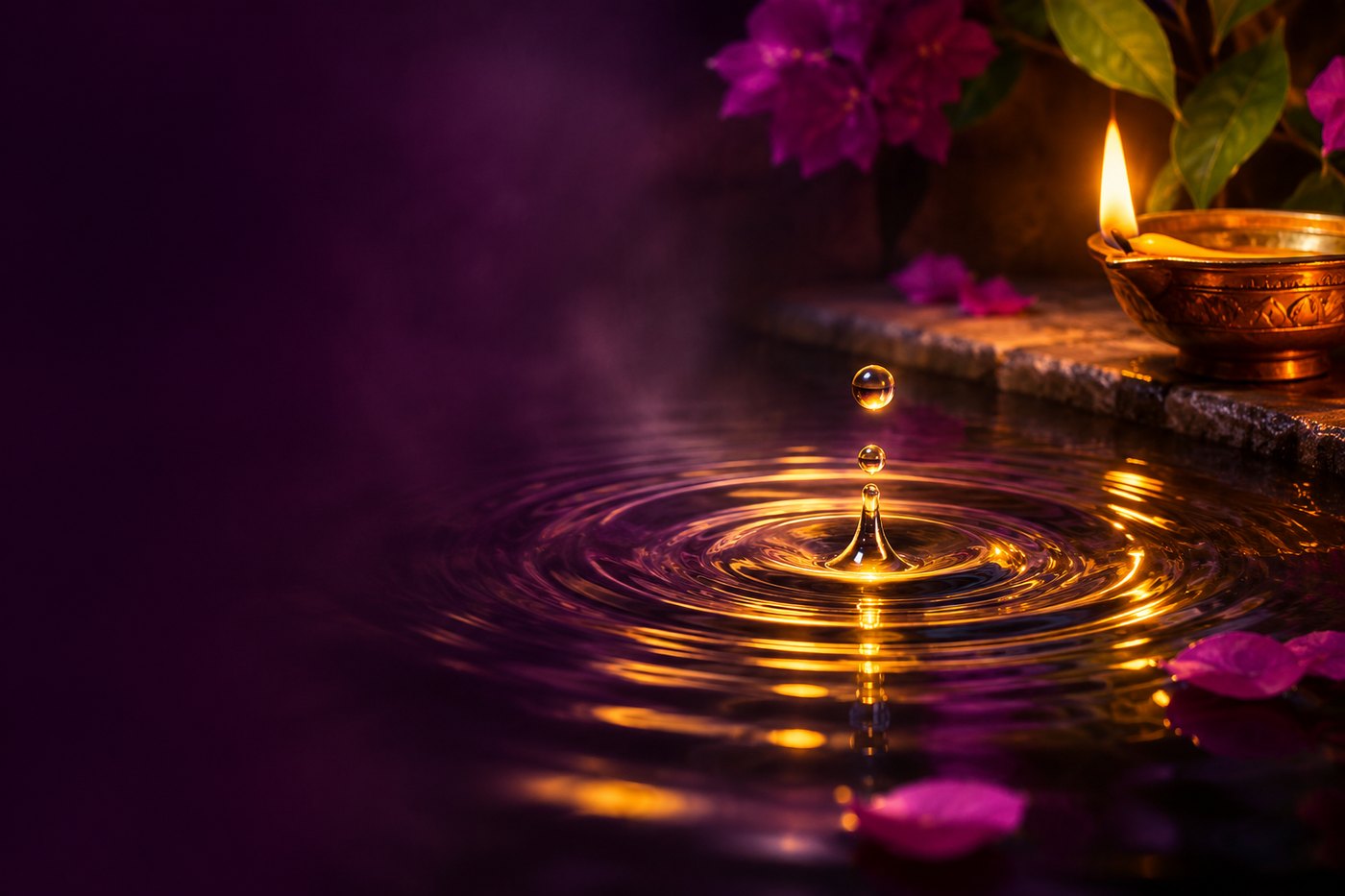
Now a drop falls from the tap and sends rings across the water. She watches them spread and cannot stop thinking about her own sentence. We will come back to that courtyard.
What most of us think karma is
Say the word and most people hear a scoreboard. Do something good and a point is added somewhere. Do something wrong and a bill is raised, to be paid later, in some form you cannot predict. Karma becomes something to fear, or something to use against others: “They will get what is coming to them.”
This version has a quiet problem. It puts the whole matter in the future and in somebody else’s hands. If karma is a delayed delivery, then there is nothing to do today except hope, or worry.
The word itself is simpler. Karma means action. The law of karma, in daily life, is only the observation that actions do not vanish when they are finished. They leave something behind. The useful question is what, and where.
The reframe: the first return is who you become
Here is the idea to keep. We think karma is about what will happen to us later. Its first return is who we become while we are doing it.
Think of Nirmala’s sharp reply. It took four seconds. Before any consequence reached her from outside, the reply had already done its work inside. For the rest of the day she was a person carrying an unfinished quarrel. She was stiffer, quicker to be annoyed, and more ready to hear criticism in a stranger’s tone.
The same holds the other way. Hand a glass of water to a tired delivery boy and you do not only change his afternoon. You have also practised being someone who notices. Each action is a small vote for the person you are becoming, and the vote is counted at once, in you.
Whatever comes back from the world afterwards is real, but it is the second return. The first one is always the quietest, and it arrives before you have finished the sentence.
Karma is not only about later. Its first return is who we become while we are doing it.
What repetition does in the brain
The brain is built to make habits. What you do and feel again and again becomes easier to do and feel, because the pathways that carry it are used more. This is true of walking to the bus stop and of snapping at the nearest person when you are tired.
That is why a single sharp reply matters less than the groove it deepens. Anger practised often becomes a short road. Patience practised often becomes one too, though it takes more days to lay.
The body takes part as well. Harsh words leave the speaker with a tight jaw and a restless mind, often long after the listener has forgotten. Small kindnesses tend to loosen the giver’s own tension. Neither is a rule without exceptions. But the pattern is common enough that you can test it on yourself, which is better than taking it on trust.
What Rajyoga teaches about karma
In Rajyoga we speak of karma as the action of the soul through the body. The soul thinks and feels first, and the body then speaks or moves. So every action has a thought at its root, and the root decides most of what grows.
Rajyoga also teaches that each action leaves an impression on the soul, which it calls a sanskar. A sanskar is a habit of the inner self: a leaning, a default way of responding. Actions done from soul consciousness, which means from the quiet awareness of being a soul and not only a role, tend to leave the soul lighter. Actions done in the heat of ego or resentment leave it heavier.
You do not have to hold any view about what happens beyond this life to use this. Whether or not you hold such a belief, the practice stands on its own: watch the thought before the action, because the thought is where you still have a choice.
The drop and the rings
Look again at the water in the tank. The drop is small, and the rings are many. They spread much further than the drop itself, and they reach the edge of the tank before you have decided what to make of them.
An action is like that. The words you speak are the drop. The rings are the mood in the room, the way the other person walks away, the voice you hear in your own head later. Nobody can stop the rings once the drop has fallen. What you can do is choose the drop.
This is why karma, read in this way, is not a fear. A scoreboard cannot be changed from where you sit. A drop can be chosen, many times in a day, before it falls.
A seven-day practice
Each day gives you one small thing to watch or do. Keep a notebook or phone note nearby.
- Day 1. Trace one action back. Pick one thing you did today, a reply, a purchase or a favour. Ask what thought started it, and what feeling sat under the thought. Just see it, without judging.
- Day 2. One breath before a reply. Choose one conversation today and take a single slow breath before you answer. Notice whether the answer you give is different from the one that was ready.
- Day 3. A kindness nobody hears about. Do one small helpful thing and tell no one, not even a friend later. Notice how it feels to keep it to yourself.
- Day 4. Name a harsh moment. Write down one harsh word or action from your day, and how you felt in the hour afterwards. Write it plainly, as you would a shopping list, not as a trial.
- Day 5. One repair. Send a message, or give a small gift, to someone you were curt with recently. Expect no reply. The repair is complete when it is sent.
- Day 6. Two minutes as a soul. Before the day begins, sit quietly for two minutes. Remind yourself, “I am a soul, and I am here to give.” Choose one quality, such as patience or warmth, and decide to give it today.
- Day 7. What came back. Look over the week and write down what returned to you, from others and from inside yourself. Include the quiet things, such as an easier mood or a lighter evening.
Back to the water tank
Another morning, the same step beside the tank. Nirmala has made poha, still warm, and packed some into a steel tiffin. She carries it across the courtyard to the neighbour’s door, says that she made too much, and adds that the tulsi will be trimmed by the weekend.
The neighbour takes the tiffin, looks a little surprised, and says thank you. It is not a long conversation, and neither of them mentions yesterday.
Back on the step, Nirmala watches a drop fall from the tap and the rings spread across the water. She notices that something in her has gone quiet. It arrived before the neighbour had even said thank you.
If you would like a steady space to practise this alongside others, you are welcome to join us in Antar Dhyan Sadhna.
What you give shapes you first, and quietly, before it reaches anyone else.