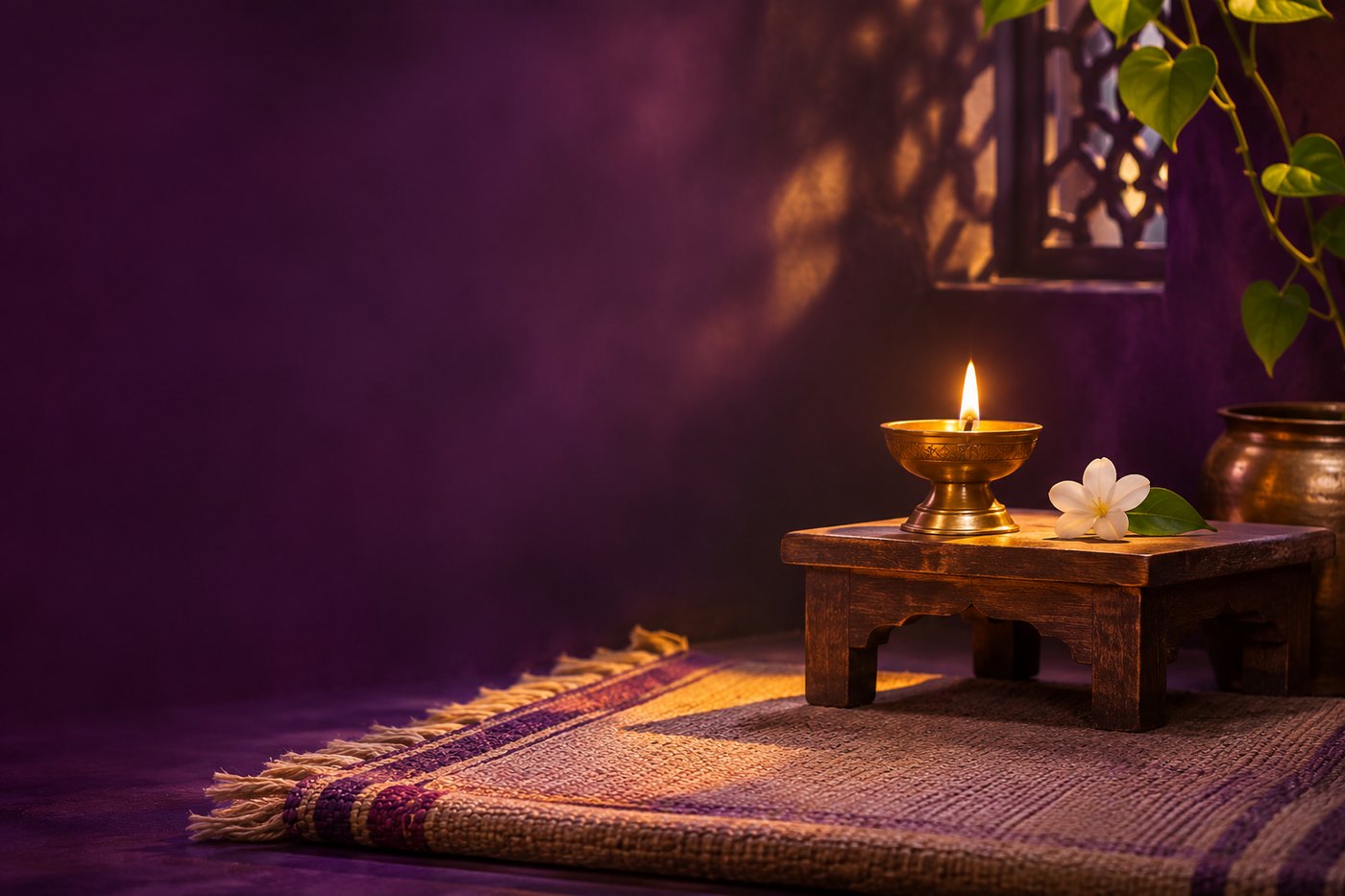
Uma is forty-seven and lives in Mysuru, where she works as a librarian in a college. Last month she bought a heavy brass diya and a soft grey cushion, because she had decided that this year she would finally meditate every morning. She set both down in the living room, quite pleased with herself.
The next morning she sat by the sofa. The day after, she sat near the television, because the floor was cooler there. On the third day she meant to sit by the window and found the newspaper had arrived first, and that the cushion now belonged to the cat. The diya stayed on its shelf, unlit and very handsome.
Keep that living room in mind. We will come back to it.
Why the pretty things did not help
Uma did what many of us do. She treated the setting as the hard part, and assumed that once the right things were bought, the sitting would follow.
But look at what actually went wrong. She never chose where she would sit. Each morning she began by deciding, and deciding takes a little energy at the exact hour when she has the least to spare. By then the mind had already started its list for the day.
Beautiful objects are pleasant to own, but they remember nothing for you.
The reframe: the corner is a memory, not a decoration
Here is the idea I would like you to keep. We think a meditation corner is about the space. It is really about the habit that the space remembers for you.
Think of where you always put your keys. You do not decide each evening. Your hand goes there by itself, because the place and the action have been joined so many times that one calls the other. A meditation corner works the same way.
So the corner does not need to be large, expensive or even attractive. It needs to be small, plain and used for one thing, at about the same time, again and again. A folded mat in the same spot that you use every morning is stronger than a whole prayer room that you visit twice a month.
The corner is not the space. It is the habit, kept safe in one small place.
What your brain does with a place
The brain is constantly linking places, times and states. Walk into the kitchen at six in the evening and your body half expects hunger. Lie on your own bed at night and sleep comes a little quicker than it does on a stranger’s sofa. Nobody taught you these links. Repetition formed them.
A familiar cue can bring the body into a known state more quickly. If you sit in one spot only for calm, and for nothing else, the spot slowly becomes a cue for calm. The breath settles a little sooner, and the shoulders drop before you ask them to.
The reverse also holds. If you meditate on the bed one day and the sofa the next, the brain has nothing to link the practice with, and each sitting starts from scratch. This is also why the corner should not double as your desk or the place where you scroll. A place that holds many states cannot hold one well.
What Rajyoga adds: the atmosphere and the seat
In Rajyoga we speak of the atmosphere that thoughts create. Rajyoga holds that a pure, peaceful thought leaves something behind, and that a place where peaceful thoughts are repeated day after day begins to carry that feeling. Whether or not you hold this view, you may know the experience: a small temple, an old library or a grandmother’s prayer corner can feel quiet before anyone says a word.
Rajyoga also asks us to remember that the corner is a reminder and not a requirement. The real seat is the soul, the tiny point of light that sits behind the eyes. The mat and the diya only help you return to that seat. If you are on a train, in a waiting room or in a relative’s spare bedroom, you can still sit as a soul. At home, the corner simply makes this easier.
Keep it small enough to survive
Most abandoned corners were too ambitious. They needed a whole afternoon to arrange and a long list of things to buy. A corner that demands that much is given up in the first busy week.
Choose a spot you already pass every day. A small patch of floor beside a window, the end of a bedroom, even a clear stretch of balcony will do. In a shared flat, you can unroll a mat on the same patch each morning and roll it up afterwards. The corner need not be permanent, but its position should be.
Keep to two or three things. One thing to sit on, one source of light and one living thing is plenty: a mat, a diya and a flower from the plant downstairs. Everything else belongs somewhere else. A simple corner can be rebuilt in five minutes after a guest has used the room.
A seven-day practice
Buy nothing new this week. Use what you already have.
- Day 1. Choose and clear. Walk through your home and pick one small spot, about the size of a doormat, that you pass every day. Clear it of whatever does not belong there, wipe it clean, and stand in it for a moment.
- Day 2. Two or three things. Place a mat or folded cloth on the spot, then one light such as a diya, a candle or a small lamp, and one living thing such as a flower, a leaf or a tulsi pot. Stop there.
- Day 3. Same time, five minutes. Choose a time you can repeat, such as just after your bath or before the house wakes. Sit for five minutes in the corner, with open eyes if that is easier, and do nothing except breathe out slowly.
- Day 4. Leave the phone outside. Put your phone in another room before you sit. The corner is the one place where nothing buzzes, and the mind will notice this within a day or two.
- Day 5. One card, one thought. Write a single thought on a small card, such as “I am peaceful” or “I am a point of light”, and keep it in the corner. Read it once, slowly, when you sit.
- Day 6. Two minutes of silence. After reading the card, close your eyes and stay silent for two minutes. Rest as a soul, a small point of light, and let the corner hold you.
- Day 7. Notice how quickly. Sit as usual, then ask how long the mind took to settle today compared with Day 3. Do not judge the answer. Just write it down, and keep the corner for next week.
Back to the living room
A few weeks later, the brass diya sits on a low wooden stool beside the window in Uma’s living room. Beside it is one white jasmine flower from the plant on the landing, and a cotton mat folded in half. The cushion has gone back to the cat, who is welcome to it.
At six every morning, before anyone is awake, she lights the diya and sits for ten minutes. Some days her mind is a market, and some days it is quiet from the first breath. What has changed is how the sitting begins. She no longer asks where she will sit. Her feet take her there, and her breath slows a little on the way.
Her husband, who has never been interested in meditation, walks past one morning and lowers his voice without being asked.
If you would like a steady space to practise this alongside others, you are welcome to join us in Antar Dhyan Sadhna.
The corner was never the space. It was the habit, kept safe in one small place.