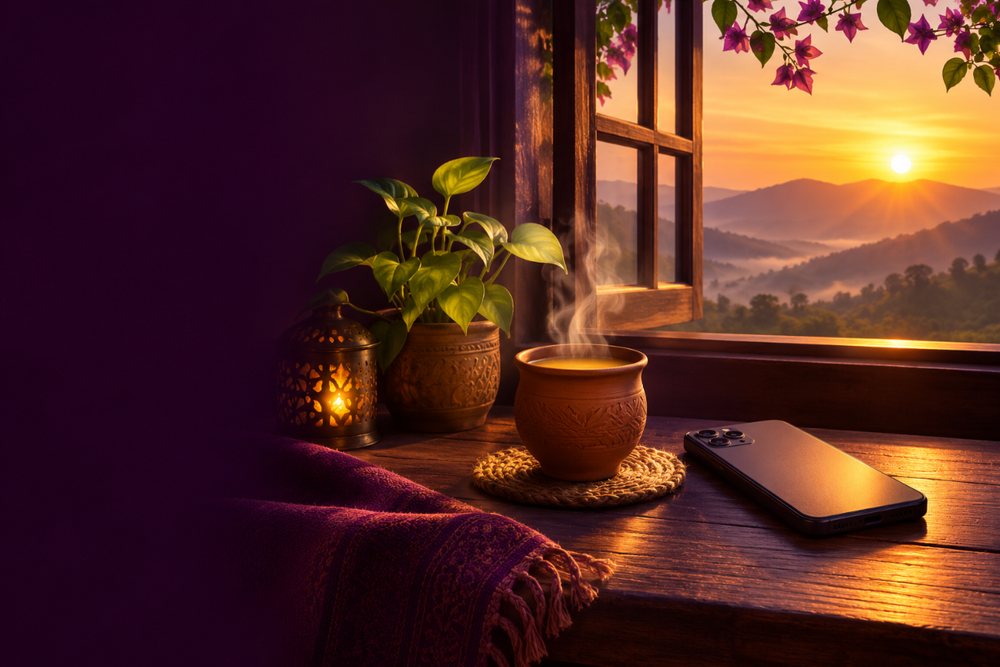
Saturday evening, and the flat is quiet. Everyone you know seems to be somewhere: a wedding, a trip, a table full of friends in a photograph. You have a cup of tea and a long stretch of hours, and you pick up your phone eleven times, as if company might be hiding inside it.
You are not unhappy, exactly. It is more like standing at the edge of a room, unsure whether to go in. Keep that quiet evening in mind. We will return to it.
Why being alone feels hard
We are social creatures, and the brain treats connection as a basic need. When we are by ourselves, the mind can briefly read it as a warning. Some of the unease you feel at the edge of an empty evening is old, and it has nothing to do with whether anything is wrong with you.
Our culture adds to it. We are taught that a full diary is proof of a full life, and that being alone means being left out. So we fill every gap with a screen, a call, a task, and we never discover what the gap might have held.
There is a second reason that is rarely said aloud. When you are alone, you meet yourself. All the thoughts you had been outrunning arrive at once, and some of them are uncomfortable. It is not the empty room that feels hard, it is the company inside it.
Loneliness and solitude are different things
The same empty evening can be lived in two ways. Loneliness is the feeling that something is missing, a hunger for connection that is not being met. Solitude is being alone and feeling whole, a kind of chosen, nourishing quiet.
The difference is not in the room. It is in how you are relating to yourself while you are in it. In loneliness, you are waiting for someone to arrive. In solitude, you have arrived.
In loneliness, you are waiting for someone to arrive. In solitude, you have arrived.
This matters because the two need different responses. Loneliness is a call to reach toward people, and that is a healthy instinct. Solitude is an invitation to rest in yourself, and it can become one of the most reliable sources of peace you have.
The reframe: you are not waiting for company, you are the company
Here is the idea I would like you to keep. When you are alone and uneasy, it is tempting to think the fix lies outside you, in a message, a plan, a person. Sometimes it does. But very often the missing thing is not another person. It is your own presence.
Most of us have a poor relationship with our own company. We treat ourselves as a place to pass through on the way to the next distraction. So when we are alone with ourselves, we feel like a host who has forgotten to welcome the guest.
Seen this way, being happy alone is not a trick of pretending you do not want people. It is a skill of becoming a person you are glad to sit with. And, curiously, the people who have this skill are often the ones with the warmest relationships, because they come to others from fullness rather than need.
What Rajyoga adds
Rajyoga describes the self as a soul, a peaceful point of conscious light, and suggests that your deepest companion is not outside you. Through meditation, you learn to sit with that inner presence and to feel that you are never fully alone, since your own awareness is always with you.
It also speaks of a relationship with the Supreme, a quiet inner connection that many people find steadying. Whether or not you hold that belief, the practice has a plain, human benefit: it gives attention somewhere gentle to rest, so that the empty evening becomes a space and not a gap.
A short sankalp can help: “I am a peaceful soul, and I am at home with myself.” You do not need to feel it at once. Repeating it softly gives the mind a new default to settle into.
What the brain gets from quiet
When you rest without input, the brain’s default network, the part that wanders and makes sense of your life, begins its quiet work. Memories sort themselves, ideas link, the mind reorganises. This is part of why some of your clearest thoughts arrive in the shower or on a walk.
If you always fill the silence, that work is interrupted. A little deliberate solitude, a walk with no headphones, a chair by the window, ten minutes of sitting, gives the mind its own time, and many people feel steadier for it.
A caution belongs here. If loneliness has become heavy, long-lasting, or is joined by low mood and hopelessness, please reach out to someone you trust or a counsellor. Solitude is nourishing when it is chosen, and isolation is not good for anyone.
When everyone else is celebrating
Some times of the year make being alone feel sharper: festivals, weekends, holidays, a friend’s wedding. Everyone seems to belong somewhere, and the silence at your own door feels louder than usual.
On such days, plan a little. Decide in advance how you will spend the evening, with something that has some warmth in it, a favourite meal, a walk at dusk, a call with one person who is easy to talk to. Do not leave the day wide open and wait to see how it feels.
It also helps to remember that photographs show the bright minutes. Behind many full tables there are people who feel unseen. Your quiet evening is not a verdict on your life, only a moment in it.
A seven-day practice
Each step takes a few minutes. None asks you to give up your friends.
- Day 1. Name the feeling. The next time you feel alone, ask, “Is this loneliness or solitude?” Write one word that describes it and a place in your body where you feel it.
- Day 2. Welcome yourself. Sit for five minutes and say inwardly, “I am here with you.” Treat yourself as a guest you are glad to see.
- Day 3. One screen-free hour. Spend an hour alone, with no phone and no input. Walk, sit, or cook slowly. Notice what the quiet is like.
- Day 4. Reach out once. Send one real message to someone you care about. Loneliness often eases with a single honest contact.
- Day 5. Do something you enjoy alone. Take yourself somewhere pleasant, a park, a cafe, a bookshop, as you would take a friend you wanted to please.
- Day 6. Sit with the sankalp. For five minutes, repeat, “I am a peaceful soul, and I am at home with myself.” Let your breath stay slow.
- Day 7. Plan one solitude ritual. Choose one small weekly ritual that is yours alone, and write when you will do it.
Back to the quiet evening
Another Saturday arrives, and the flat is quiet again. You glance at the phone once and leave it where it is. The tea is warm. The window shows the last light going.
You notice the old unease at the edge of the room, and this time you walk in. There is no one there but you, and that turns out to be enough, more than enough, to fill the hour.
If you would like a steady space to practise this alongside others, you are welcome to join us in Antar Dhyan Sadhna.
Being alone was never the problem. Not knowing who was in the room was.