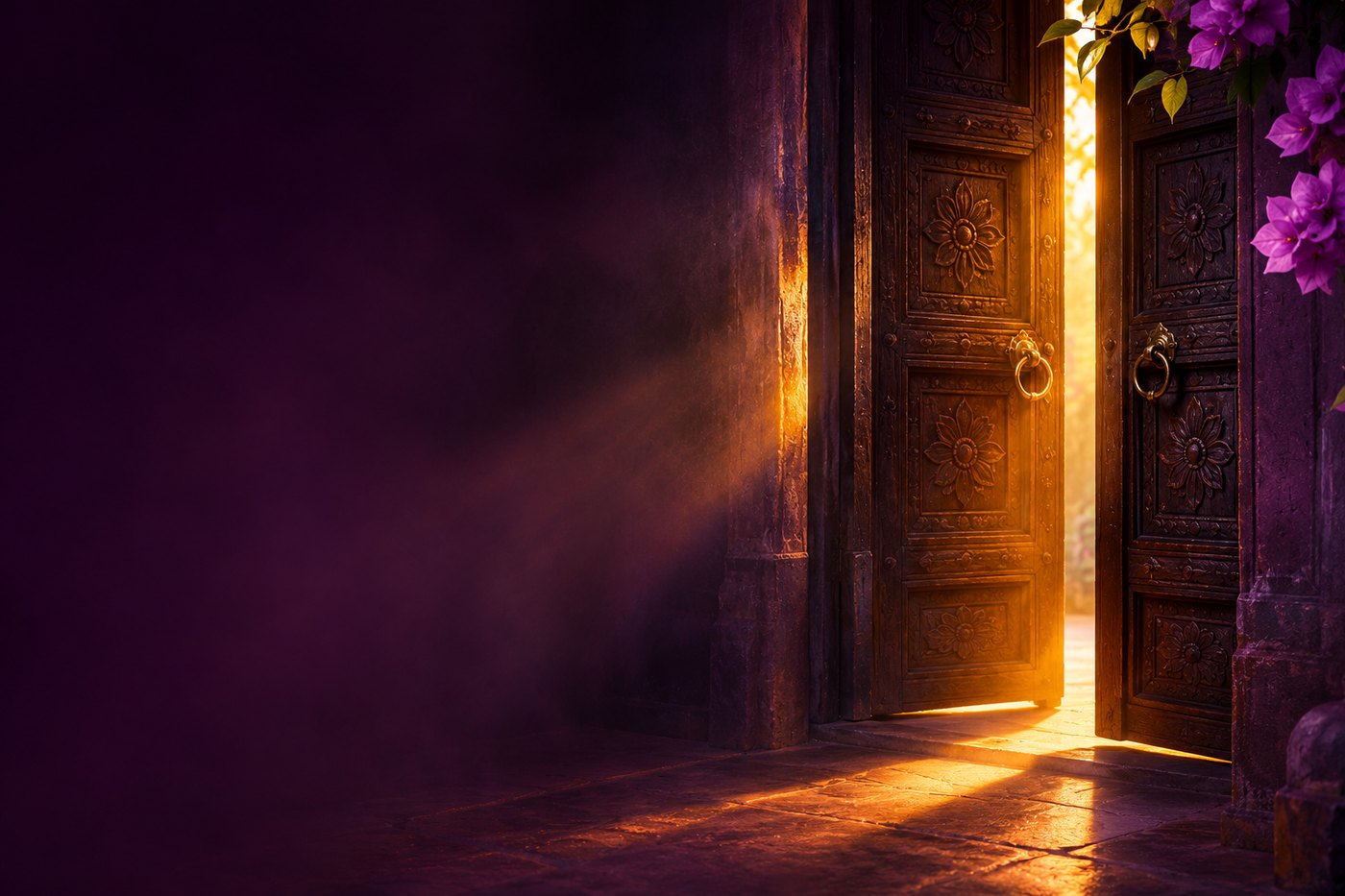
Faisal is thirty-seven and lives in Lucknow. For eight years he has taken the same route to the same office, and tonight, after dinner, he is standing in the old corridor of his family house. The light is off. In front of him is a carved wooden door that his grandfather made by hand, its panels worn smooth by decades of palms.
He is thinking about everything he has not started. The course he bookmarked two years ago. The conversation with his manager. The small side project he describes to friends as “something I might do”. He stands there for a long while, and nothing in him moves.
Leave him at that door for now. We will come back to it.
What stuck usually looks like
When people say they feel stuck, they often picture a wall. Nothing is happening, and they cannot push through. But look closely at Faisal’s week and you will find a great deal of motion. He wakes at the same time, thinks the same worries on the same commute, and eats the same dinner while thinking about the same unfinished things.
That is not standing still. It is walking in a small circle, quickly and for a long time. The circle is so familiar that it stops feeling like movement at all, and you end the day tired without having arrived anywhere.
This matters because a wall and a circle ask for different things. A wall needs force. A circle needs only that you step off it, in any direction, even a short way.
Why waiting for clarity keeps you in the circle
Most of us have an unspoken rule. First I will understand what I really want, and then I will act. So we wait. We read, we think, we ask ourselves the big question again at night, and the answer does not come, because we are asking it from inside the circle with the same information we had last month.
The wait feels responsible. It is also how eight years pass.
The reframe: clarity is what movement leaves behind
Here is the idea in one line. We wait for clarity before we move, but clarity is usually what movement leaves behind.
We wait for clarity before we move. Clarity is usually what movement leaves behind.
Think of walking into an unfamiliar railway station. You do not know which platform is yours, and no amount of standing at the entrance will tell you. You walk a few steps, you see a board, you notice which way people are going, and the picture clears. The first step did not require knowing. It produced the knowing.
Life works in much the same way. A short course, a conversation, a trial week, a visit to a place you have never been: each gives you something the circle never could. You find out what you enjoy, what you dislike, who helps and what it costs. Then your next decision rests on something real, not on a guess made at midnight.
What the mind does when you are stuck
A stuck mind tends to repeat. The same thoughts return in the same order, and each replay makes them feel more true. The mind also tends to overestimate what could go wrong with a change, while the cost of staying put stays quiet, because it arrives slowly and nobody sends you a notice.
There is a gentler side to this too. Finishing even a small task gives a sense of progress, and that sense tends to bring more energy for the next task. A tiny completed action often lifts motivation more than a large plan does, which is why a plan that stays a plan can leave you feeling heavier.
So the aim is not a brave leap. It is a step small enough that the mind does not bother to argue.
A word of care. If feeling stuck comes with low mood on most days, loss of interest in nearly everything, or thoughts of not wanting to live, please speak to a counsellor or a doctor, or call a local helpline. This practice supports you. It does not replace that help.
What Rajyoga adds about habit and silence
Rajyoga teaches that you are a soul, a point of light and energy, and that the mind runs on sanskars, which are impressions left by past thoughts and actions. A thought repeated often enough becomes a groove, and the mind slides back into it without being asked. In this view, the same loop keeps circling because the groove is deep, not because you are weak.
Rajyoga also teaches that a new thought, held with sankalp (a firm, quiet resolve), is how a new sanskar begins. One clear thought such as “I will do this one small thing today”, repeated and acted on, starts a fresh line beside the old groove.
And Rajyoga puts value on silence. A few minutes of sitting quietly as a soul, apart from the role of employee, son or husband, gives some distance from the situation. You see it a little as a visitor would. Whether or not you hold this view, the practice is useful: a short pause before deciding often shows you an option the busy mind had hidden.
A seven-day practice
Each day asks for something small. Keep a notebook nearby.
- Day 1. One line. Write a single sentence that says where you feel stuck, such as “I feel stuck in my work and I do not know what I want.” Do not solve it. Naming it plainly is enough for today.
- Day 2. Draw the circle. List what you repeat every day, from waking to sleeping, including the thoughts. Look at it as if it belonged to a stranger and notice which parts are habit, not choice.
- Day 3. Ten minutes, any direction. Choose one action that takes under ten minutes and do it now. Send the enquiry, open the course page, clear the shelf. It does not have to be the right action, only a real one.
- Day 4. A fresh pair of eyes. Talk for fifteen minutes with someone who knows you but sits outside your daily circle, perhaps an old friend or a cousin in another city. Ask what they see in you that you have stopped noticing.
- Day 5. Change one small thing. Move your desk, take another road home, or spend this evening somewhere other than the sofa. A different setting loosens the groove, even a little.
- Day 6. Two minutes of silence. Before you decide anything today, sit for two minutes. Remind yourself, “I am a soul, a point of peaceful light,” and let the question rest. Then decide.
- Day 7. What the week taught you. Write what each small move showed you, including the ones that felt flat. Choose the next small step for next week from what you learned, not from what you feared.
Back to the carved door
Some weeks later, Faisal is in the same corridor in the evening. It has been a quiet stretch, and he did not plan anything large. On the second night he opened the course page and read the first lesson. Then he sent one message to an old friend who had changed careers, and she called him back and talked for twenty minutes.
Tonight he is carrying a cup of tea past the carved door. It is slightly ajar, left that way after he fetched a notebook from the room beyond. The corridor feels less closed than it did. Nothing about his life has been solved, and he does not pretend it has. But he knows a little more than he did a month ago, and he can see which way to turn next.
If you would like to work on this one to one, a private session is available through 1-to-1 consultation.
The door was never locked. He had only been waiting to feel sure before touching it.