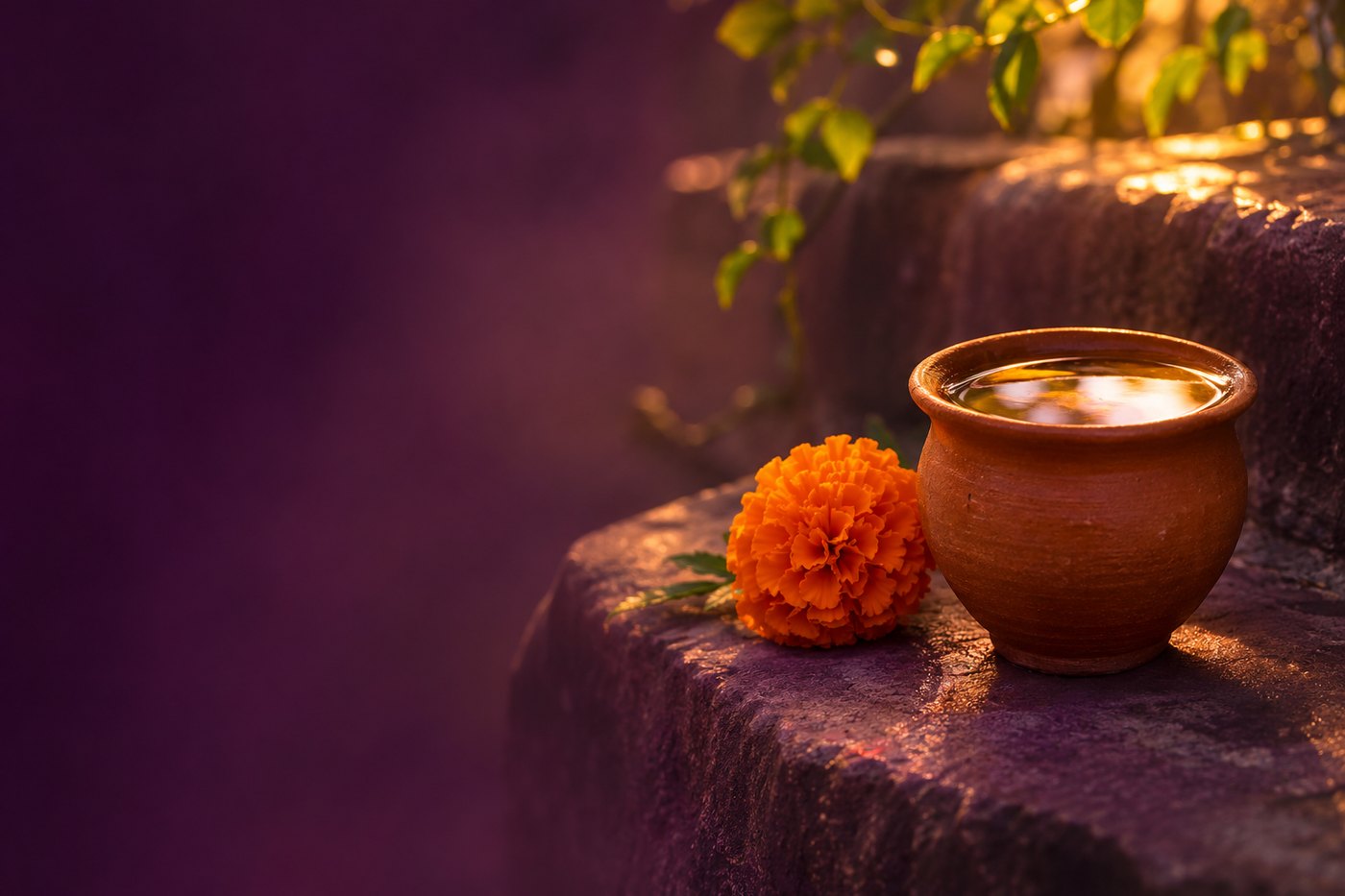
Prakash is fifty, and he retired from the railways in Nagpur last spring. At evening he sits on the stone step outside his house with a clay cup of water beside him and a marigold from the morning puja. The lane is quiet. The day has asked nothing of him.
Then he opens a relative’s photographs on his phone. A new car, white and shining, with garlands on the bonnet. He scrolls slowly, and something in his chest becomes smaller. His own house, his pension and his evening all seem to have shrunk while he was looking. We will come back to that step.
The number that keeps moving
Most of us carry a quiet figure in our heads. It might be a salary, a flat, a size of house, a number in a savings account. When we reach it, we believe, we will finally relax. Until then, enough is somewhere ahead.
The trouble is that the figure moves. When you earned less, enough was a little more than you had. Now you earn that amount and enough has gone ahead of you, as a horizon does when you walk towards it. The wanting was never a matter of the amount. It was a way of standing.
This is why two people with very different incomes can both feel behind, and why one person can sit with very little and look settled. The number was never the thing that decided it.
What the mind does with every gain
The mind adapts quickly. A new phone, a new job, a bigger room, all feel wonderful for a few weeks and then become simply normal. The pleasure does not vanish. It is absorbed, and the wanting comes back looking for the next thing.
Comparison makes this sharper. Whenever we look at what someone else has, the mind quietly draws a line between their life and ours and calls the gap lack. Prakash had everything he had an hour before the photographs arrived. Nothing was taken from him. Only the line was drawn.
The gentle remedy is attention. Research suggests that noticing and savouring what is already present slows the mind’s habit of getting used to things. It does not erase wanting, but it gives the good that is here a fair hearing before the mind moves on.
The reframe: when you feel enough, you can tell what you need
Here is the idea I would like you to keep. We think contentment comes after we have enough. It works the other way. When we feel enough, we are finally able to tell what we actually need.
A person who chases from emptiness cannot sort their wants. Everything feels urgent, because each thing seems to promise relief from the same hollow feeling. A person who is already somewhat full can look at the new car, the new course or the new job and ask a clean question: do I need this, or do I only want to feel less small?
This is why contentment is not the same as giving up. A contented person can still plan, save, learn and ask for more. The difference lies in where the wanting comes from. Wanting from fullness is light, and it can be dropped if the answer is no. Wanting from emptiness grips, and even a yes does not satisfy it.
What Rajyoga adds
Rajyoga names contentment, santosh, as one of the treasures of the soul, along with peace and love. It holds that a content soul is rich whatever it holds in its hands, and that a restless soul remains poor whatever it owns.
According to Rajyoga, this contentment does not come from adding anything. It comes from remembering yourself as a soul, whole and peaceful in your own right, and from connecting with the Supreme, the source of peace. When that remembrance is fresh, the mind stops trying to fill itself from outside.
Nor is this laziness. Complacency stops moving because it does not care. Santosh keeps moving because it has nothing to prove. A content soul still acts, with its full effort, but without the restlessness that makes every task feel like a race.
Contentment is not the end of wanting. It is wanting without the emptiness behind it.
Visiting enough
You cannot reach enough by working harder, but you can visit it in a few minutes. The doorway is attention, and it begins by noticing what is already full in an ordinary moment: the first sip of tea, the cool of the step in the evening, the sound of someone cooking in the next house.
Nothing needs to be changed to do this. The aim is not to talk yourself out of wanting more. It is to let your system learn that fullness is available now, before anything else arrives. The more often you visit, the less you need an outside number to tell you where you stand.
Some days the feeling will not come, because you are tired or carrying worry. That is fine. Try again the next day with the same small moment. Contentment grows by repetition, as a path does.
A seven-day practice
Each step takes only a few minutes. Treat it as a visit, not an exam.
- Day 1. Find a full moment. Notice one moment today that already felt full, such as the first sip of chai or a quiet walk to the door. Stay with it for ten slow breaths.
- Day 2. Ask need or number. Once today, when you want something, ask, “Is this a need or a number?” Do not answer in a hurry. Just let the question sit.
- Day 3. Savour one ordinary thing. Choose a simple thing, such as a meal, a cup of water or a window. Give it a full minute of unhurried attention, as if you were meeting it for the first time.
- Day 4. One hour without comparison. Close one feed for an hour, whether it is photographs, news or a group chat. Notice what the mind does when it has no one to measure itself against.
- Day 5. Sit as a full soul. For two minutes, sit quietly and think, “I am a peaceful soul, and I am full in myself.” Let your breath go slowly, and do not try to feel anything particular.
- Day 6. Do one thing well. Choose one task, and do it fully, without reaching for the next one. When your hands finish, pause for a breath before you begin again.
- Day 7. Write what enough felt like. Write three or four lines on what enough felt like this week and where it came from. Keep the page somewhere you will see it.
Back to the step
Weeks later, Prakash is on the same stone step in the evening, with the same clay cup and a fresh marigold. The cup is filled to the brim, and he does not move it, because moving it would spill. The lane is quiet again.
His phone is in his pocket. A relative has a new car, and he is glad for them, and he finds that the gladness does not need to be paid for with his own smallness. He lifts the cup and drinks slowly. The evening feels full, and nothing has been added to it.
If you would like a steady space to practise this alongside others, you are welcome to join us in Antar Dhyan Sadhna.
Enough is not a figure you reach. It is a place you can step into, right where you are.